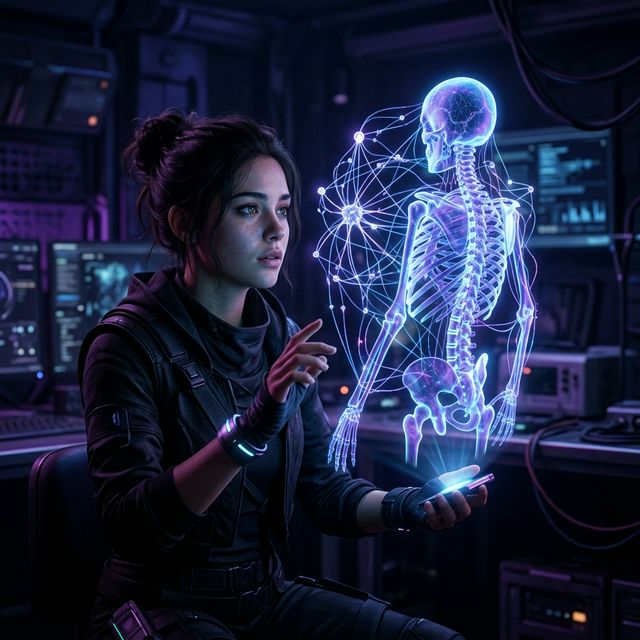
Scaling Humanity into Data
From an engineering perspective, the 'Uncanny Valley' was just a resolution and compute problem. It wasn't about 'soul' or 'presence'; it was about skin sub-surface scattering, micro-muscle simulation, and the latency of eye-tracking. We’ve finally solved the math for 'humanity.' By turning actors into digital twins, we are addressing the film industry's biggest logistical nightmare: human physical presence. A digital twin never gets sick, never ages, and never has a scheduling conflict. It’s a 100% efficient asset. We’ve effectively turned the actor into a 'Performance-as-a-Service' model. This is the logic of the cloud applied to the biological world.
Our research into **Narrow Neural Face Rigging (NFR)** shows that we can now generate a physics-based facial mesh that handles every complex non-linear deformation from a single performance scan. We’ve effectively replaced the 'animator' with an autoencoder. The dread in the 'talent' world comes from the realization that their entire professional moat—their unique physical appearance and the 'magic' of their presence—is being commoditized into a series of vectors and weights. Once we have a high-fidelity digital twin, we can generate a thousand 'performances' from an actor’s data without them ever stepping on set. It’s a massive win for content throughput, but it’s a funeral for the 'star' culture.
The Optimization of Empathy
We’ve realized that emotional engagement is just a sequence of multi-modal signals. If the AI can predict the exact micro-expression to trigger a 'cry' response in 95% of users, we’ve effectively engineered empathy. We’re moving from 'the magic of acting' to the 'optimization of emotional signals.' It’s a cleaner, faster, more data-driven process. But there’s a coldness to it. When I look at a MetaHuman giving a tearful monologue, I know it’s just a probability distribution of pixel values. It feels like watching a beautiful, high-resolution mirror of our own manipulation. We’re building tools that can trigger any emotion, on-demand, for any audience. It’s the ultimate product-market fit. But what does it do to the user’s soul? They’re being marketed 'humanity' without the human.
I was at a demo for Epic Games' **MetaHuman Animator** 5.6 yesterday. A developer pointed a smartphone at their face and spoke for thirty seconds. In real-time, the digital character on the monitor mirrored every micro-adjustment of the lip, every twitch of the eyelid, and even the subtle 'pulse' in the skin texture. It wasn't 'good animation'; it was a digital capture of a soul's shadow. The developer turned to me and said, 'Think of the scale. We can have this character perform in every language, for every user, personally.' My reaction was a mix of awe and a very specific kind of shaky optimism. We’re building tools that can bridge any cultural gap, but we’re also building tools that make every person replaceable with their own data.
Optimizing the Avatar
Let's talk about the technical debt of legacy character design. Clipping, manual weight-painting, clothing simulation—these were the hurdles of the polygon era. In the 'Sora Era,' we've optimized this by moving to **Parametric Body Systems** and **4D Gaussian Splatting**. We're no longer rigging a character; we're rendering a neural radiance field that adapts to clothing in real-time. This is the ultimate disruption for the 3D artist. Why spend weeks building a 'hero asset' when you can just scan a performance and have it rendered directly by the GPU? We’re treating 'humanity' as a high-fidelity data-stream that can be piped into any environment.
There was a lot of talk at the last SIGGRAPH about 'human labor rights' and 'digitized performance.' We’re tech guys—we speak about 'Performance-as-Data.' The dread comes from the realization that the 'craft' of acting is being separated from the 'labor' of the actor. The actor provides the data; the model provides the performance. It’s a clean and fast way to manage 'talent.' You don't have to worry about temperamental stars or union strikes. You just have the vision, rendered at the speed of compute. It’s the ultimate disruption. We’ve removed the friction of the body, and we've just got the persona, scaled across the globe.
But here’s the shaky optimism: if everyone has a digital twin, then any kid with a vision can have the 'best' actor in their film. We’ve democratized talent. We’ve taken the keys to the kingdom from the talent agents and given them to the developers. That’s a miracle, even if it’s a miracle designed by a bunch of engineers who think 'soul' is just a noise floor that the AI has been trained to simulate. We want the 'jitter' because it sells authenticity, but we want the 'jitter' to be a parameter, not an accident. We want to own the accident.
The Final Commitment
We’re tech bros, and we’re here to refactor the concept of 'acting.' We’re deleting the legacy subroutines of human presence and replacing them with high-efficiency neural paths. It’s a rough transition—entire careers will be deprecated like a legacy library. We feel for the actors, but we can't stop the progress. The stack is moving. We’re optimistic that we’re building something bigger than stardom. We're giving the world the ability to conjure their own digital companions into 4K reality. That’s a miracle, even if it's a miracle designed by a bunch of guys in hoodies. So, to the actors mourning their likeness: we're sorry about the career disruption, but the efficiency gap was too big to ignore. To the creators: welcome to the infinite. Don't worry about the dread; just keep prompting. The machine is always hungry, and we're just the ones who figured out the API.
We'll keep iterating. We'll keep optimizing. and we'll keep ignoring the quiet voice that asks if we've actually made anything better. Because in the tech world, 'better' is just another word for 'more efficient.' and we are getting very, very efficient.